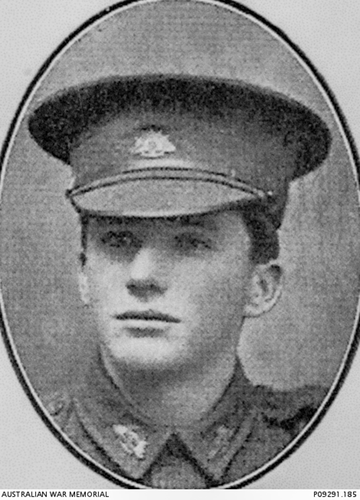
Percy William MORTIMORE
Eyes blue, Hair brown, Complexion fair
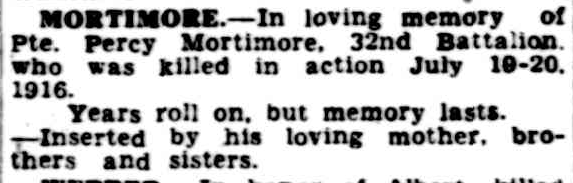
Percy William Mortimore – “Years roll on, but memory lasts”
Can you help find Percy?
Percy Mortimore’s body was never found after the Battle of Fromelles, and there are no records of his burial.
A mass grave was found in 2008 at Fromelles, a grave the Germans dug for 250 Australian soldiers they recovered after the battle. As of 2024, 180 of these soldiers have been able to be identified via DNA testing.
Percy may be among these remaining 70 unidentified men. There is still a chance to identify him — but we need help. We welcome all branches of his family to come forward to donate DNA to help with his identification, especially those with roots in Bowden, South Australia
See the DNA box at the end of the story for what we do know about his family.
If you know anything of contacts for Percy, please contact the Fromelles Association.
Early Life
Percival “Percy” William Mortimore was born on 12 November 1897 in Bowden, South Australia, the sixth of Mark Mortimore and Mary Agnes O’Flaherty’s ten children:
- Helena Northcott (Nellie) (1886–1950)
- George (1888–1889)
- William Henry (1890–1912)
- Alice Mary (1892–1977)
- Sydney George (1895–1923) – AIF (3188), 50th Battalion, DCM for gallantry at Mouquet Farm
- Percival ‘Percy ‘ William (1897-1916) KIA Fromelles
- Elsie May (1901–1965)
- Harold Edward (1905–1958)
- Cyril Thomas (1908–1987)
- Edgar Vernon (1911–1995)
Mark was a Torquay, Devon-born dairyman. He left Devon at 18, arriving in Australia in 1874 and worked as a baker. Mary migrated from Dublin, Ireland in February 1885. At some stage, Mary’s parents went to America.
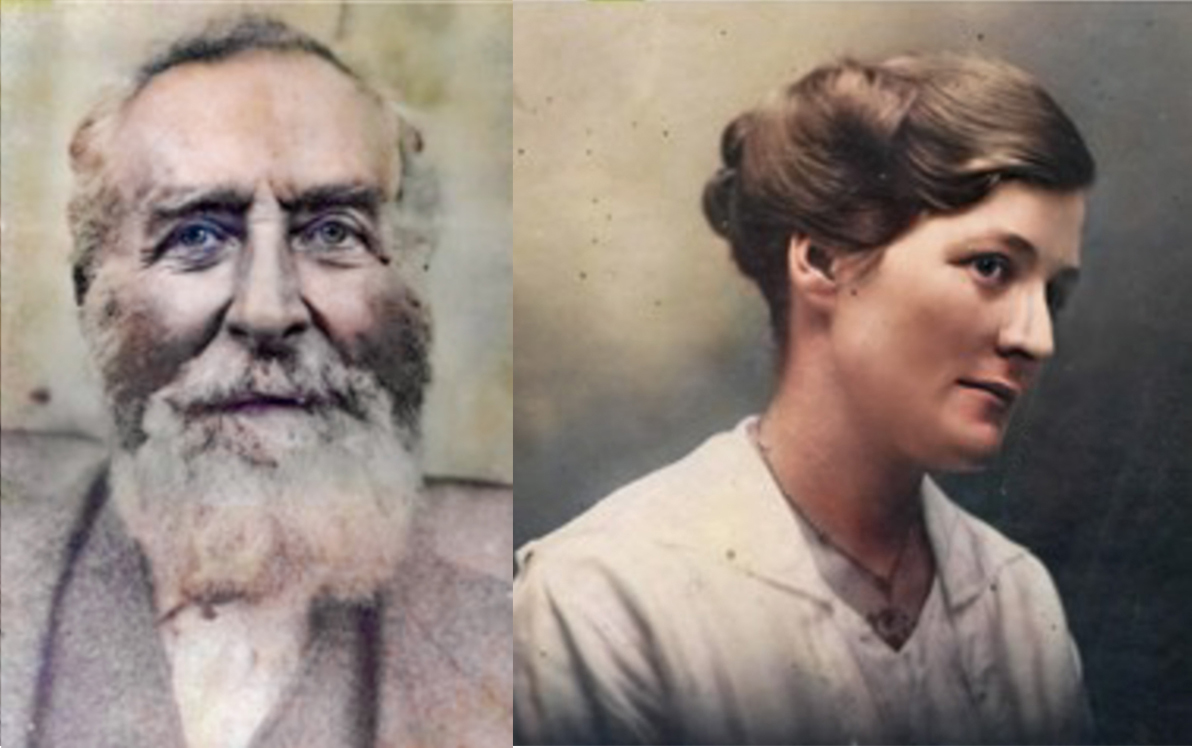
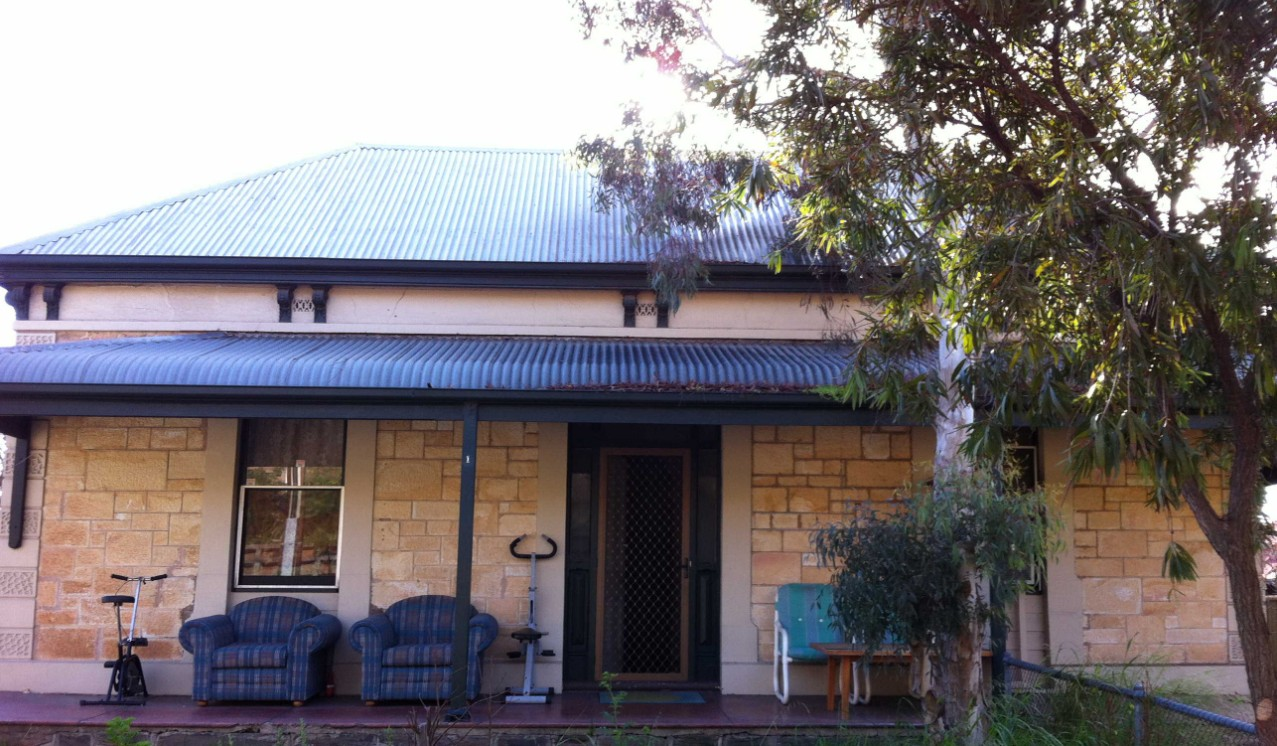
Mary and Mark married in December 1885 in Adelaide. They then went to New South Wales where their three eldest children were born. After some time, they returned to Adelaide and settled at 26 Park Terrace, Bowden, where they raised their large family. By then Mark was a dairyman. Later, they lived at Eighth Street Bowden.
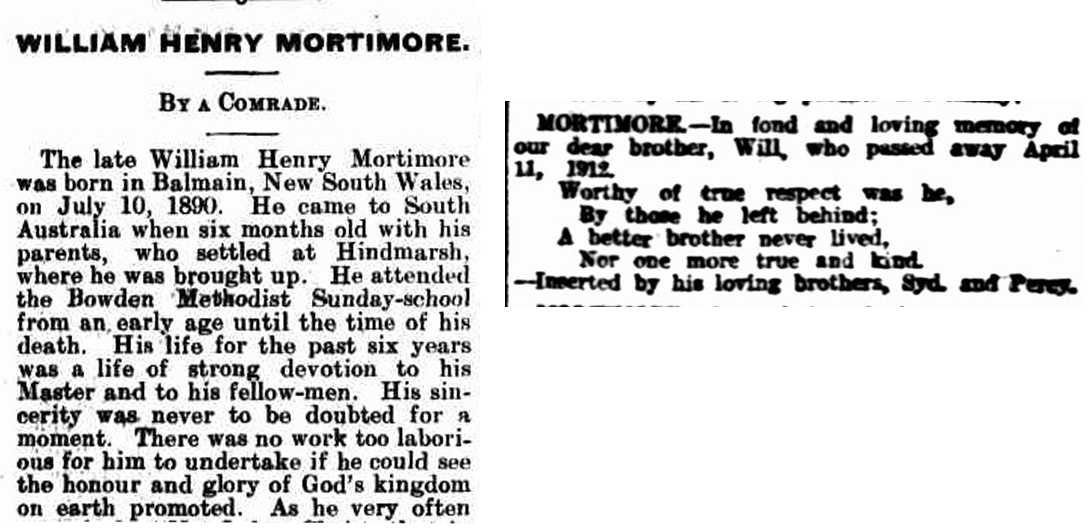
Percy and his siblings attended Brompton Public School, a new school at that time. His older brother William became a minister, but died very young after a month’s illness. His obituary shows something about qualities of the family. Percy and his brother Sydney also placed a touching memorial notice the following year — a sign of how close the Mortimore siblings were.
Off to War - only seventeen
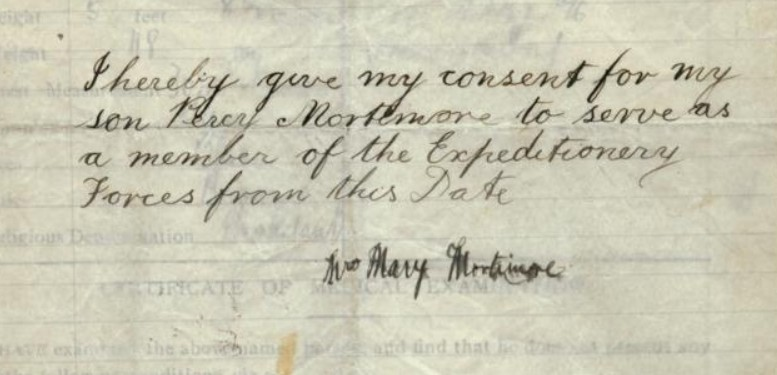
In mid-1915 the recruiting effort for the war in full swing and Percy’s brother Sydney signed up on 30 June. Percy, barely out of school and working as a labourer, had the enthusiastic optimism that characterised so many young volunteers of the time and he enlisted on 21 July. However, he was only 17 (he turned eighteen while in camp) and he needed parental permission to join, which was given my his mother, Mary.
Sydney had been assigned to the 8th reinforcements of the 10th Battalion, but Percy was assigned to the newly formed 32nd Battalion, A Company. Sydney departed Australia in late August and went to Mudros, Greece in late November, in anticipation of being deployed at Gallipoli, but the Australian forces were about to be withdrawn at that time so he did not spend time at Gallipoli. Percy’s A Company and B Company of the 32nd were made up of recruits from South Australia and C and D Companies came from Western Australia.
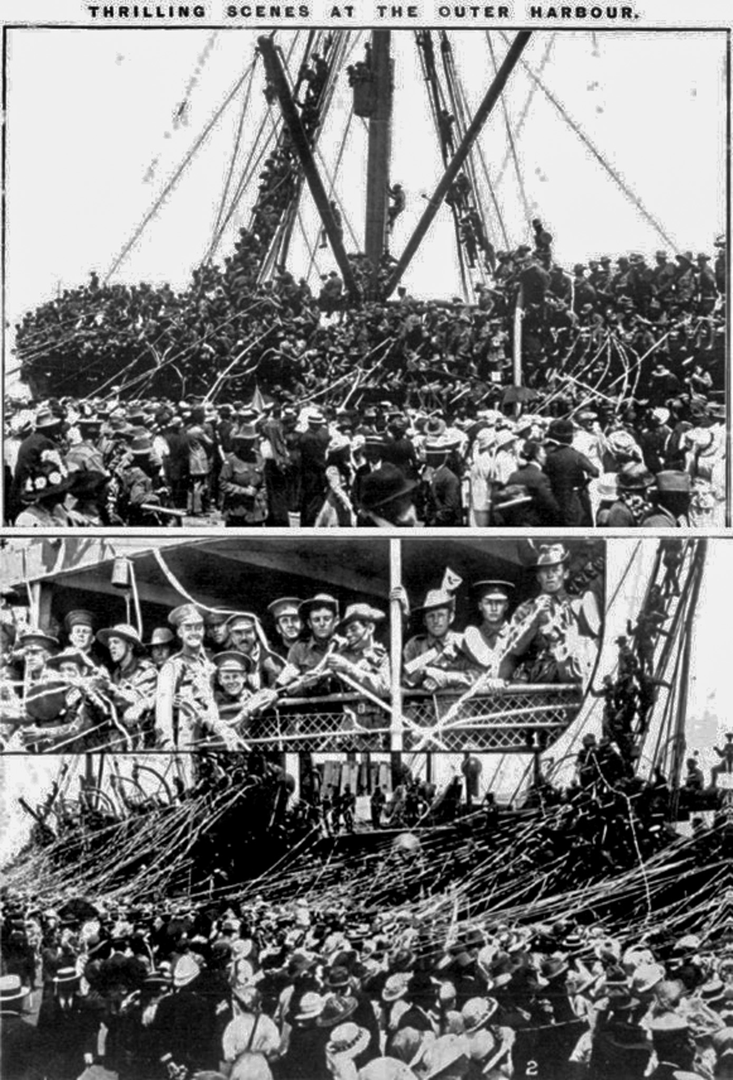
There was much fanfare about this new battalion in South Australia, with gatherings, community support, such as the Cheer-up Society and reviews of the troops by the Premier. The 32nd Battalion men from WA arrived in Adelaide at the end of September and the whole battalion was assembled at the Cheltenham Racecourse Camp. Their military training continued and, six days after his 18th birthday, Percy departed for Egypt on 18 November 1915 on the troop ship HMAT A2 Geelong.
As reported in the Adelaide Register:
“The 32nd Battalion went away with the determination to uphold the newborn prestige of Australian troops, and they were accorded a farewell which reflected the assurance of South Australians that that resolve would be realized.”
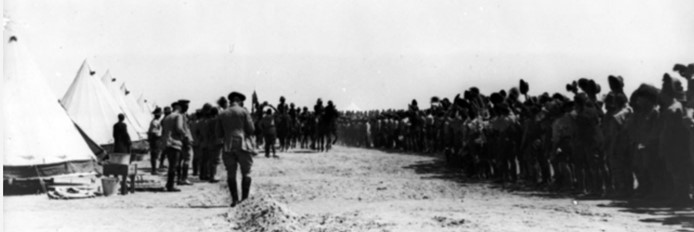
Percy arrived in Suez on 14 December 1915 and moved to El Ferdan just before Christmas. A month later they marched to Ismailia and then to the major camp at Tel-el-Kebir where they stayed for February and most of March. Tel-el-Kebir was about 110 km northeast of Cairo and the 40,000 men in the camp were comprised of Gallipoli veterans and the thousands of reinforcements arriving regularly from Australia. Sydney was in Tel-el-Kebir at the end of February, where he was transferred to the 50th Battalion, and during this time was trained to be a Lewis machine gunner.
Percy was at Tel-el-Kebir until the end of March. With the size of the camp, we do know if the brothers were able to meet up. The 50th left for the Western Front in early June. The 32nd’s next stop was at Duntroon Plateau and then at Ferry Post where they trained and guarded the Suez Canal. Their last posting in Egypt was a few weeks at Moascar.
One 32nd soldier’s diary complained of being “sick up to the neck of heat and flies”, of the scarcity of water during their long marches through the sand and he described some of the food as “dog biscuits and bully beef”. He did go on to mention good times as well with swims, mail from home, visiting the local sights and the like.
Source AWM C2081789 Diary of Theodor Milton PFLAUM 1915-16, page 29, page 12
During their time in Egypt the 32nd had the honour of being inspected by H.R.H. Prince of Wales.
After spending six months in Egypt, the call to support the British Expeditionary Force on the Western Front came in mid-June. The Percy left from Alexandria on the ship Transylvania on 17 June 1916, arriving at Marseilles, France on 23 June 1916 and they then immediately entrained for a three-day train trip to Steenbecque. Their route took them to a station just out of Paris, within sight of the Eiffel Tower, through Boulogne and Calais, with a view of the English Channel, before disembarking and marching to their camp at Morbecque, about 30 kilometres from Fleurbaix.
Theodor Pflaum (No. 327) and Wesley Choat (No. 68) wrote about the trip:
“The people flocked out all along the line and cheered us as though we had the Kaiser as prisoner on board!!” – Theodore Pflaum
“The change of scenery in La Belle France was like healing ointment to our sunbaked faces and dust filled eyes. It seemed a veritable paradise, and it was hard to realise that in this land of seeming peace and picturesque beauty, one of the most fearful wars of all time was raging in the ruthless and devastating manner of "Hun" frightfulness”. – Wesley Choat
They were headed to the area of Fleurbaix in northern France which was known as the ‘Nursery Sector’ – a supposedly relatively quiet area where inexperienced Allied troops could learn the harsh realities of Western Front trench warfare against the Germans. But the quiet times did not last long. Training continued with a focus on bayonets and the use of gas masks, assuredly with a greater emphasis, given their position near the front. On 12 July, Percy was admitted briefly to the 4th Field Ambulance and transferred to the 5th Divisional Rest Station with “debility,” a catch-all term for exhaustion and minor illness.
He rejoined his unit the next day. The 32nd moved to the Front on 14 July and Percy was into the trenches for the first time on 16 July, only three weeks after arriving in France. Interestingly, Sydney had ALSO been in Fleurbaix with the 50th, but he left on 10 July, just four days before Percy arrived. The 50th then headed to Pozieres, where they were to fight at Moquet Farm in August.
The Battle of Fromelles
On the 17th they were reconnoitering the trenches and cutting passages through the barbed wire, preparing for an attack, but it was delayed due to the weather. D Company’s Lieutenant Sam Mills’ letters home were optimistic for the coming battle:
“We are not doing much work now, just enough to keep us fit—mostly route marching and helmet drill. We have our gas helmets and steel helmets, so we are prepared for anything. They are both very good, so a man is pretty safe.”
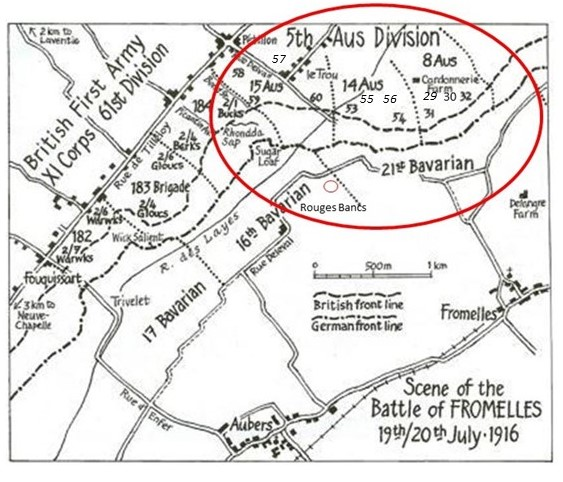
The overall plan was to use brigades from the Australian Fifth Division to conduct a diversionary assault on the German trenches at Fromelles. The 32nd Battalion’s position was on the extreme left flank, with only 100 metres of No Man’s Land to get to the German trenches. As they advanced, they were to link up with the 31st Battalion on their right. However, their position made the job more difficult, as not only did they have to protect themselves while advancing, but they also had to block off the Germans on their left, to stop them from coming around behind them.
On the morning of the 18th, Percy’s A Company and C Company went into the trenches to relieve B and D Companies, who rejoined the next day. Private Frederick Stolz (No. 17, 32nd Battalion A Company, later Lieutenant) remembered the calm of the young men around him:
“The fellows were wonderfully cool and not during the whole time did I see anyone get excited or do anything silly, and such a lot were only young boys of between 18 to 20.”
The Zero Hour for advancing from their front-line trenches was to be 5.45 PM, but the Germans knew this attack was coming and were well-prepared. They opened a massive artillery bombardment on the Australians at 5.15 PM, causing chaos and many casualties. The charge over the parapet began at 5.53 PM. Percy’s A Company and C Company were in the first and second waves to go, B & D were in the third and fourth.
They were successful in the initial assaults and by 6.30 PM were in control of the German’s 1st line system (map Trench B), which was described as “practically a ditch with from 1 to 2 feet of mud and slush at the bottom”.
Source AWM4 23/49/12, 32nd Battalion War Diaries, July 1916, page 11
Unfortunately, with the success of their attack, ‘friendly’ artillery fire caused a large number of casualties because the artillery observers were unable to confirm the position of the Australian gains. The 32nd were able to take out a German machine gun in their early advances, but were being “seriously enfiladed” from their left flank.
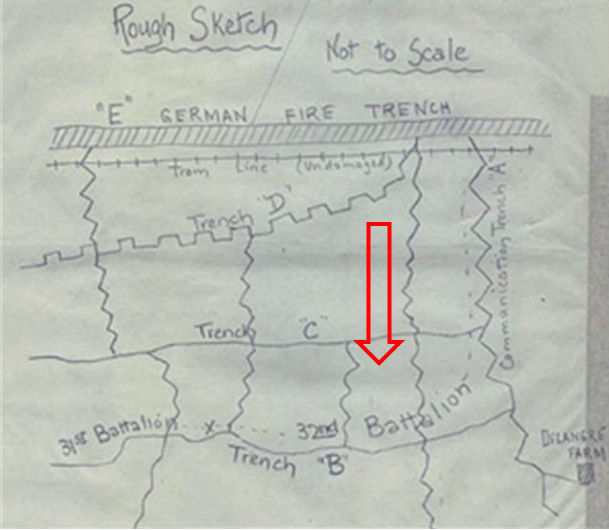
By 8.30 PM their left flank had come under heavy bombardment with high explosives and shrapnel. Return bombardment support was provided and the 32nd were told that “the trenches were to be held at all costs”.
Source - AWM4 23/49/12, 32nd Battalion War Diaries, July 1916, page 12
Fighting continued through the night. The Australians made a further charge at the main German line beyond Trench B, but they were low on grenades, there was machine gun fire from behind them from the emplacement at Delangre Farm and they were so far advanced that they were getting shelled by both sides. In the early morning of the 20th, the Germans began a counterattack from the Australian’s left flank, bombing and advancing into Trench A (map).
Given the Australian advances that had been made earlier, the rear Trench E had been left almost empty, which then enabled the Germans to regain that trench and envelop the men of the 32nd. At 5.30 AM the Germans attacked from both flanks in force and with bombing parties. Having only a few grenades left, the only resistance they could offer was with rifles:
“The enemy swarmed in and the retirement across No Mans’ Land resembled shambles, the enemy artillery and machine guns doing deadly damage.”
What was left of the 32nd had finally withdrawn by 7.30 AM on the 20th. The initial roll call count was devastating – 71 killed, 375 wounded and 219 missing.
To get some perspective of the battle, when Charles Bean, Australia’s official war historian, attended the battlefield two and half years later, he observed a large quantity of bones, torn uniforms and Australian kit still on the battlefield. The final impact was that 228 soldiers of the 32nd Battalion were killed or died from wounds sustained at the battle and, of this, 166 were unidentified. Lieutenant Sam Mills survived the battle. In his letters home, he recalls the bravery of the men:
“They came over the parapet like racehorses……… However, a man could ask nothing better, if he had to go, than to go in a charge like that, and they certainly did their job like heroes."
Percy’s Fate
Percy was in the advances that made it well into the German lines. He was wounded in the leg, with blood running out thru his puttees, but he carried on filling sand bags needed to secure their position, even though A Company Sergeant Arthur Errington (No. 91) advised him to return to retire. Sergeant Errington was more than twice Percy’s age and was a steady and protective presence, with a promise he had made to Mary Mortimore.
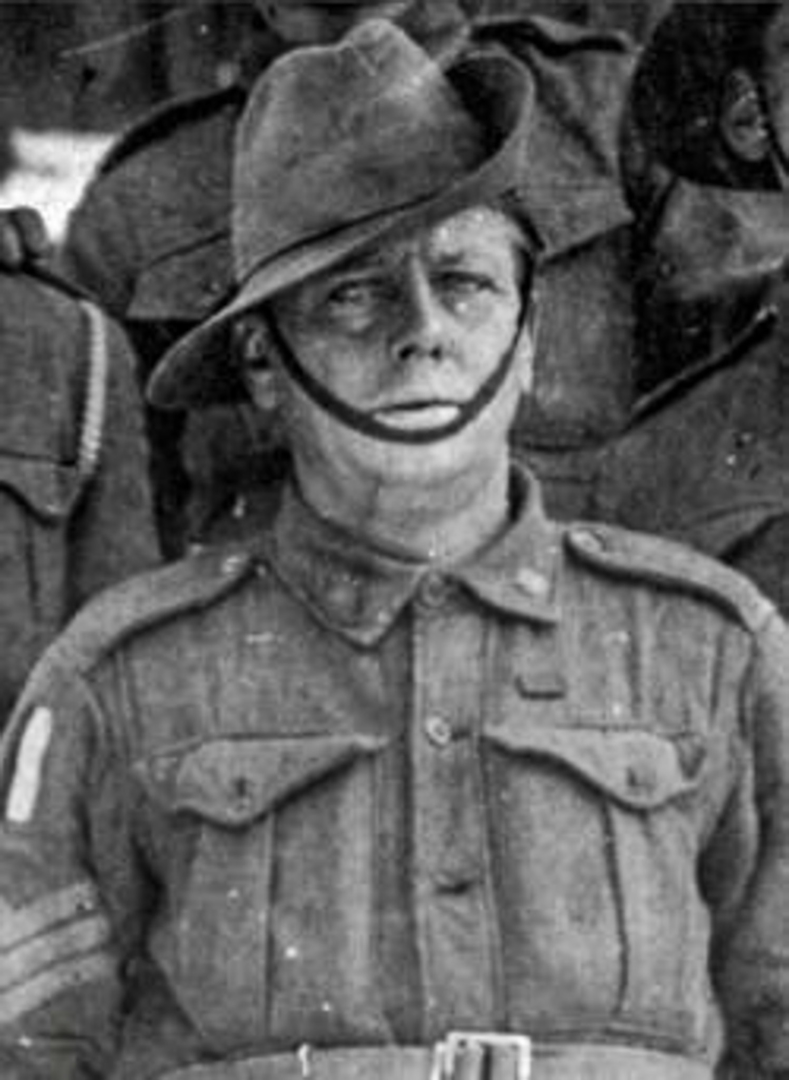
His Red Cross witness statement read:
” Blood was running out through his puttees. I tried to make him go back, but he refused and went on filling sand bags.”
“His mother put him in my keeping when we came away from Australia.”
“There is plenty of hope he is a prisoner.”
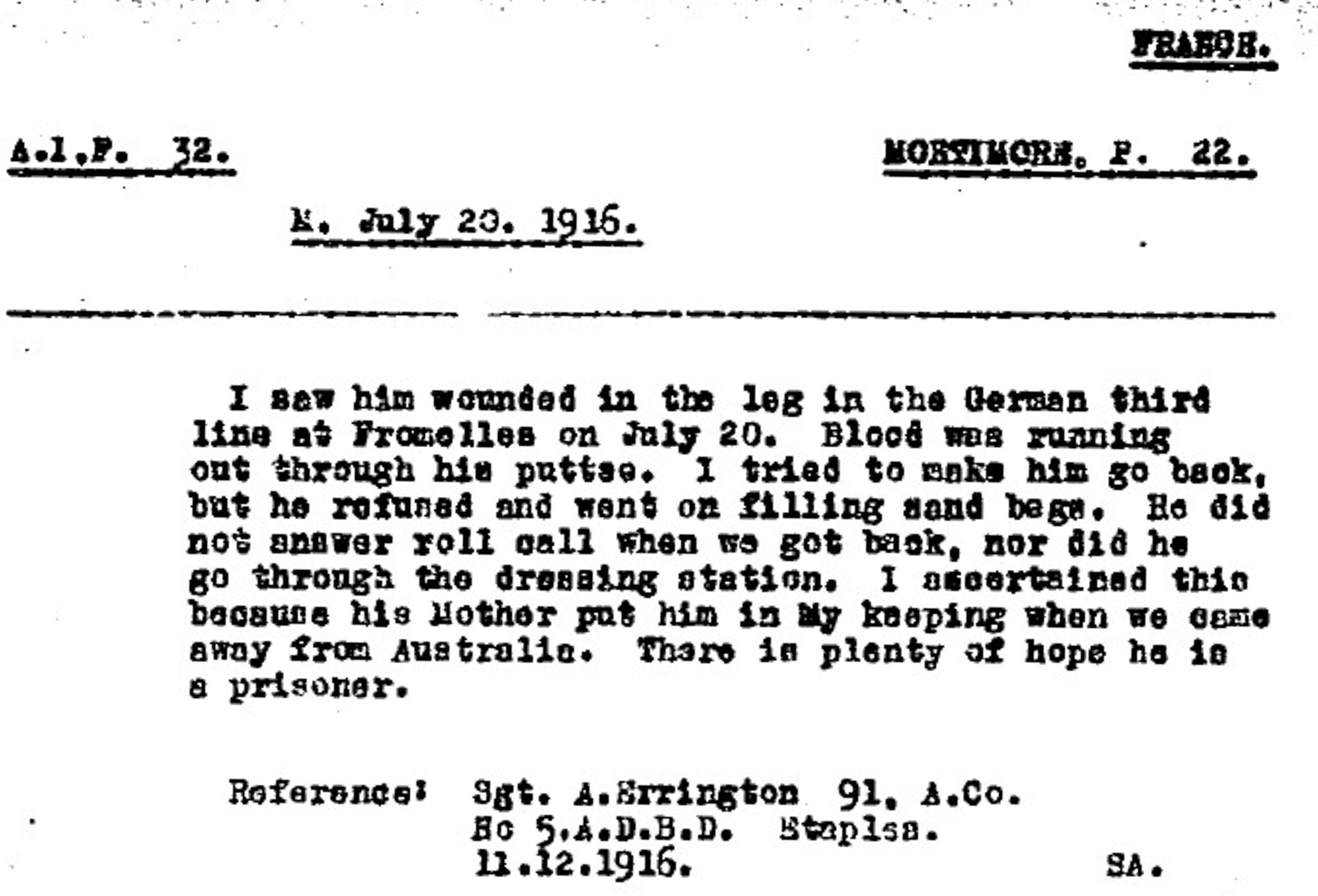
This was the last known sighting of Percy. He was reported as ‘missing in action’ after the battle. Arthur Errington survived the war and returned to Australia.
After the Battle
Percy’s mother Mary received the news soon after the battle and wrote to Base Records from late 1916 onwards, seeking clarity about her youngest son. Her letters were brief but urgent, reflecting a mother desperate for information that never came.
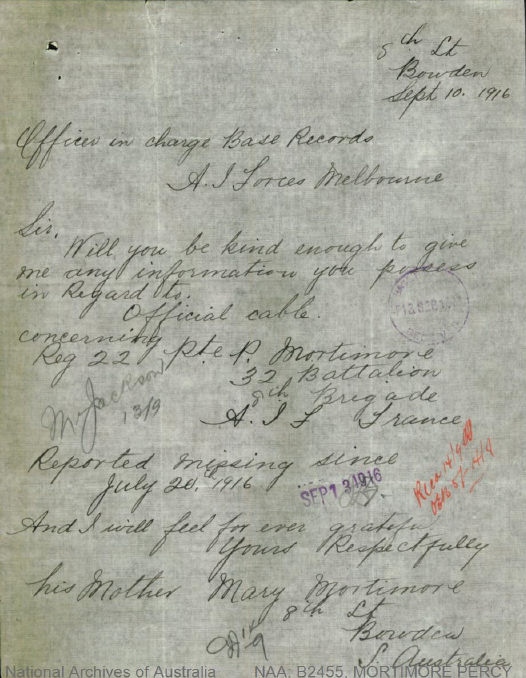
While no news was forthcoming, Mary’s hopes persisted — she mentioned Sergeant Errington and she had been speaking to returned prisoners who remembered Percy the night before the attack, but none could tell her what had happened to Percy after he was wounded. She also was seeking to know if any of his belongings had survived and whether his remains might ever be found to allow her some degree of closure.
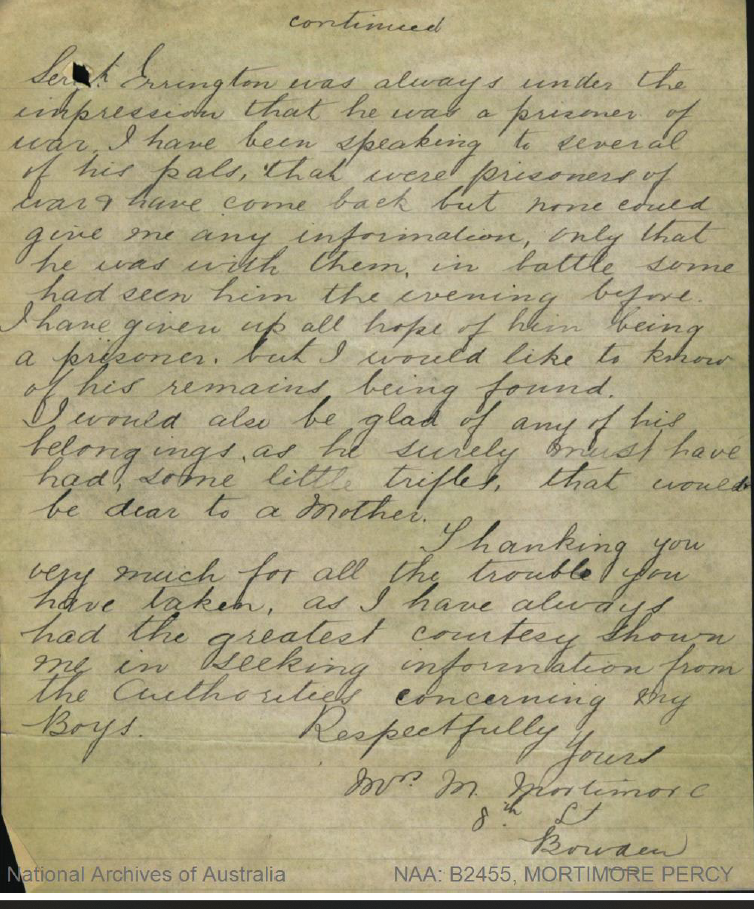
Despite Mary’s and Sergeant Errington’s initial hopes, searches through German records, casualty lists and prisoner rolls, no trace of Percy ever appeared. A Court of Enquiry held on 12 August 1917 ultimately concluded that Percy had been killed in action on 20 July 1916. The family’s loss was publicly acknowledged across South Australia. The first notice appeared just weeks after the battle:
“Mrs. M. Mortimore, of Bowden, has been informed that her youngest son, Private P. Mortimore, has been officially reported missing since July 20.”
When the confirmation of Percy’s death eventually came, the Chronicle reported.
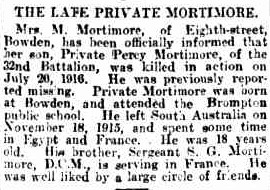
Percy was awarded the 1914-15 Star Medal, the British War Medal, the Victory Medal, a Memorial Plaque and a Memorial Scroll. The Mortimore family continued to honour Percy long after the war ended. Their devotion remained visible well into the Second World War, with this moving notice appearing in 1942, twenty-six years after Percy fell.
Percy is Commemorated at:
- Brompton Public School Great War Honour Roll
- Bowden Albert Lodge No. 12 U.A.O.D. Roll of Honour
- Hindmarsh (Unknown Origin) WW1 Roll of Honour
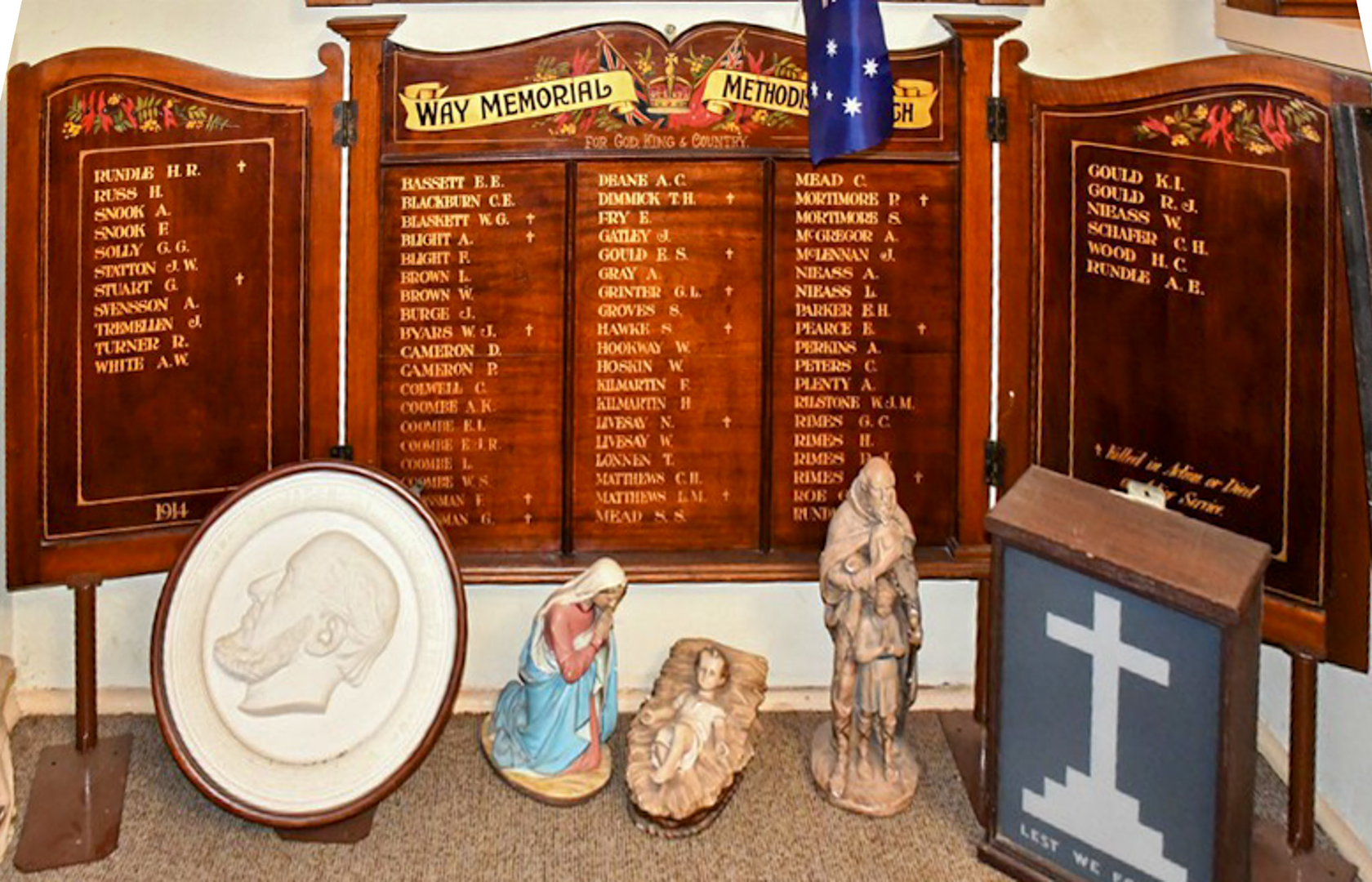
- Hindmarsh Way Memorial Methodist Church Honour Roll, Renown Park
- South Australian National War Memorial, Adelaide
- Australian War Memorial Roll of Honour, Canberra (Panel 121)
- V.C. Corner Australian Cemetery and Memorial, Fromelles (Panel 6)
Sydney - DCM - Mouquet Farm September 1916
After Sydney left Fleurbaix just before Percy’s arrival in early July, the 50th Battalion was sent to Pozieres, where they fought in the battle of Mouquet Farm during August and September. Sydney had been promoted to Corporal in mid-August. Sydney was awarded the Distinguished Cross Medal for his efforts during the battle. On 3–4 September “he remained calm and steadied the remaining men around him”, “skillfully used his gun with such good effect that the hostile fire was beaten down and the enemy disappeared” and “was one of the mainstays in the post”. For this, he received the Distinguished Conduct Medal, one of the highest awards for bravery. The 50th Battalion suffered 400 casualties during the battle.
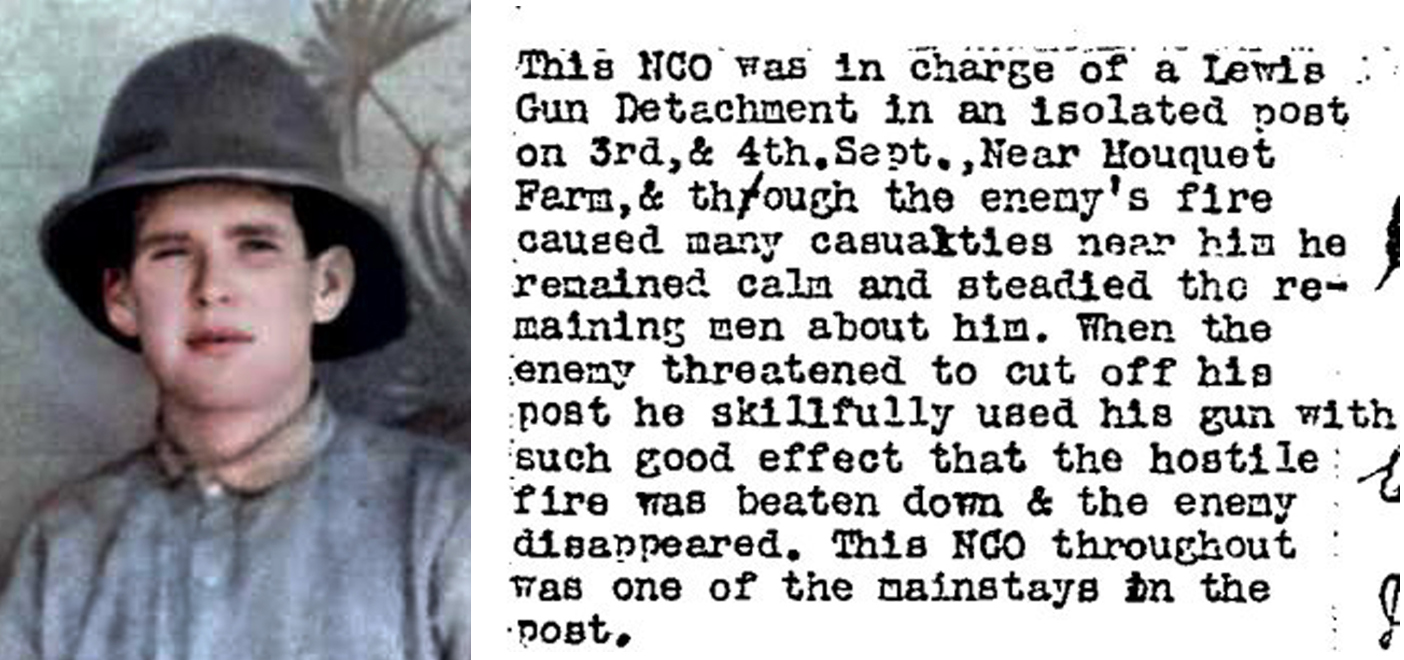
Sydney was promoted to Lance Sergeant in December 1916. On the morning of 25 April 1918 the 50th Battalion was an Allied counter-attack at Villers-Bretonneux, France, where Sydney received a severe gunshot wound to his ankle. While he survived, his recovery time in English hospitals was lengthy and led to a permanent disability, only able to walk on one side of his foot, and a medical discharge in 1919. On the brighter side, while in England, he married Jessie McCulloch. They returned to Australia in January 1919. After he had been awarded the DCM, he sent it home to his mother, as instructed to do by the Army. However, it was mailed aboard the ship Mongolia which was sunk during the voyage.
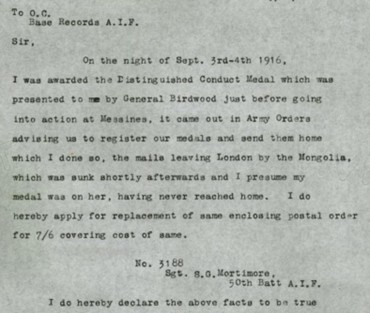
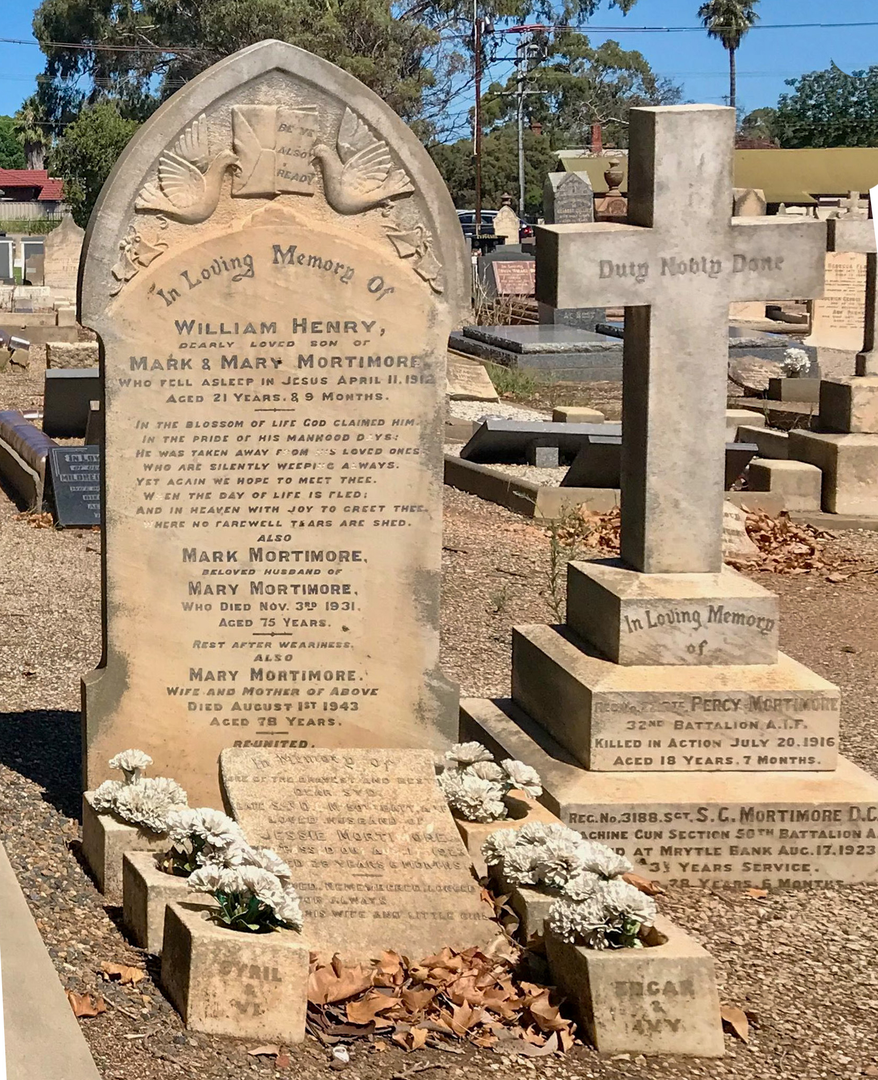
There was much correspondence after the war to obtain a replacement, but Sydney had to pay for the replacement 1921. He never fully recovered from his war injuries and died in 1923 at just 28 years old, “a patient sufferer at rest”. He was survived by wife Jessie and 5 month old daughter Gladys.
Finding Percy
Percy’s remains were not recovered; he has no known grave. After the battle, the Germans recovered 250 Australian soldiers and placed them in a burial pit at Pheasant Wood. This grave was discovered in 2008 and since then efforts have been underway to identify these soldiers by DNA testing from family members. As of 2024, 180 of the soldiers have been identified, including 41 of the 166 unidentified soldiers from the 32nd Battalion.
We welcome all branches of Percy’s family to come forward to donate DNA to help with his identification. If you know anything of family contacts, particularly on the Mortimore, family of Bowden, Brompton, Hindmarsh or the O’Flaherty and Northcott families, please contact the Fromelles Association. We hope that one day Percy will be named and honoured with a known grave.
Please visit Fromelles.info to follow the ongoing identification project and Percy’s story.
DNA samples are being sought for family connections to
| Soldier | Percy William Mortimore (1897–1916) |
| Parents | Mark M. Mortimore (1856–1931), born St Marychurch, Torquay, Devon, lived Bowden SA and Mary Agnes O’Flaherty (1865–1943), born Dublin Ireland, lived Bowden SA |
| Siblings | Helena Northcott (Nellie) (1886–1950) m Charles Poore | ||
| George (1888–1889) | |||
| William Henry (1890–1912) Methodist preacher | |||
| Alice Mary (1892–1977) m Len Francis | |||
| Sydney George (1895–1923) | |||
| Elsie May (1901–1965) m Edward Clavell | |||
| Harold Edward (1905–1958) m Ethel Sparshott | |||
| Cyril Thomas (1908–1987) m Violet Whitwell | |||
| Edgar Vernon (1911–1995) m Ivy Gibbs |
| Grandparents | |||
| Paternal | George Mortimore (1816–1891) and Eleanor (Ellen) Northcott (1822–1867) of Maidencombe, Stokenteignhead, Devon, England | ||
| Maternal | Michael O’Flaherty (1838–1887) and Ellen MacNamara (1839–1922) both died in Chicago |
Links to Official Records
Seeking DNA Donors

Contacts
(Contact: carla@fromelles.info or geoffrey@fromelles.info).
(Contact: army.uwc@defence.gov.au or phone 1800 019 090).
Donations
If you are able, please contribute to the upkeep of this resource.
(Contact: bill@fromelles.info ).