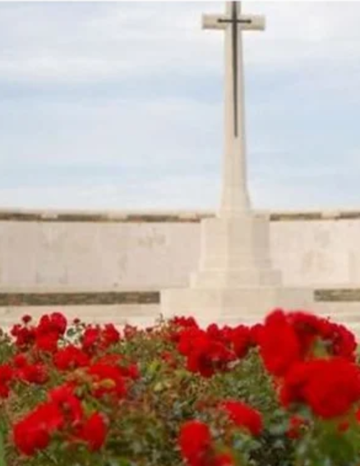
Edward CLINCH
Eyes brown, Hair brown, Complexion fresh
Edward “Ted” Clinch – "Take My Wallet and Things and Send Them Home to My Wife"
Early Life
Edward Clinch, know as Ted, was born on 8 May 1879 at Stargo Creek, near Ballan, Victoria, the son of Edward Clinch (1842–1913) and Esther Hester Phelan (1851–1914). Ted grew up in a large working-class Victorian family during a period when the small farming and mining communities west of Melbourne were expanding rapidly.
Children of Edward and Esther Clinch:
- Frances Fanny (1876–1918)
- Thomas (1878–1945)
- Edward “Ted” (1879–1916) KIA Fromelles
- Margaret Ellen (1881–1950)
- Sarah (1883–1883) died infancy
- Hannah (1884–1886)
- Rose May (1887–1963)
- Jane (1891–1961)
- James Morris (1893–1968)
By the early 1900s the family had moved into Melbourne’s inner northern suburbs, particularly Fitzroy and Collingwood. Edward’s father worked as a plasterer, while Edward himself became a blacksmith striker, a physically demanding trade involving heavy forging work and assisting blacksmiths in workshops and industrial yards.
In 1912 Edward married Louisa May French (1888–1953) in Victoria. The couple made their home at 4 Mater Street, Collingwood, a small working-class street near Smith Street and the industrial heart of inner Melbourne. Their lives, however, were touched by tragedy even before the war. In October 1912, a murder occurred at the Clinch family home in Mater Street. Louisa’s step-sister, Carrie Hart, was shot and killed there by her estranged husband, Harry Hart, in an act of domestic violence that received widespread newspaper coverage across Victoria. Louisa witnessed the aftermath of the shooting inside the family home.
Source: 'TRAGEDY AT COLLINGWOOD.' (1912, October 26). Weekly Times (Melbourne, Vic. : 1869 - 1954), p. 33. Retrieved 16 May 2026, from http://nla.gov.au/nla.news-article222599729
Despite the trauma surrounding the family, Edward and Louisa built a life together in Collingwood. Military pension records later show they were caring for Doris Kathleen Young, who was officially recognised as their adopted daughter after Edward’s death. Later records also suggest Louisa may have raised or adopted additional girls in the years following the war. Edward’s mother Esther died in 1914, only a year before he enlisted. In addition. Louisa was expecting when Edward embarked,and gave birth in 1916 to baby Edward who sadly lived only one day. Also in 1916 Louisa Clinch officially adopted Doris who was about 4 years old at the time.
Off to War
Edward Clinch enlisted in the AIF on 1 July 1915 at Melbourne, Victoria, joining the 6th Battalion, 9th Reinforcement. At 36 years of age, he was older than many of the men volunteering beside him, but like thousands of Australians after Gallipoli, he answered the call for reinforcements as the war expanded beyond Egypt and the Dardanelles. He did his initial military training at the Broadmeadows Camp, outside of Melbourne.
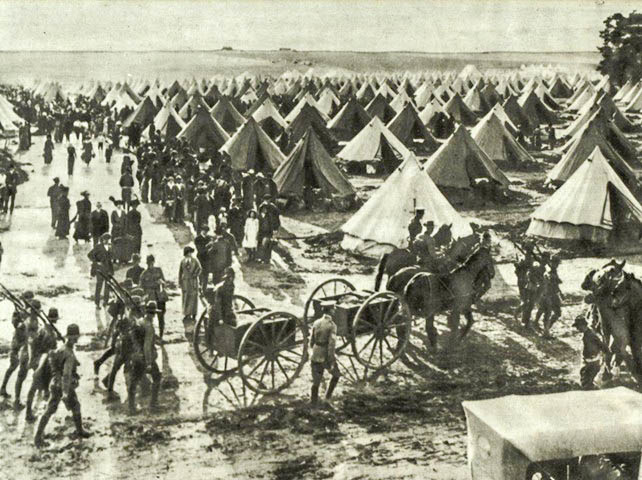
He embarked from Melbourne on 10 September 1915 aboard HMAT A16 Star of Victoria. The 58th Battalion was raised on 17 February 1916 in Egypt as part of the expansion of the Australian Imperial Force following the Gallipoli campaign. Half of the battalion’s strength came from experienced Gallipoli veterans transferred from the 6th Battalion, while the other half consisted of fresh reinforcements recently arrived from Australia. Together they became part of the 15th Brigade in the newly formed 5th Australian Division. Edward was transferred to the newly formed 58th Battalion on 17 February 1916 during the reorganisation of the AIF in Egypt.
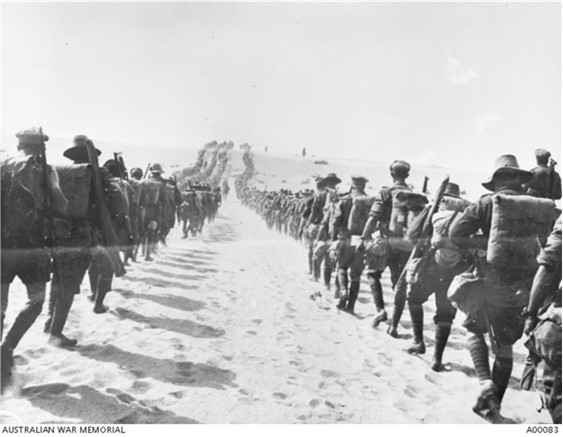
The battalion trained in the desert camps and undertook guard duties along the Suez Canal. Heat, dust, flies, and long marches became part of daily life as the men prepared for service on the Western Front. On 17 June 1916, the battalion boarded HMT Transylvania at Alexandria and sailed for France, arriving at Marseilles on 23 June. After disembarking, the men travelled north by train for three days before arriving near Fleurbaix, where further training was carried out behind the lines. The battalion continued preparing for front-line service through route marches, trench instruction, and specialist training, including the use of gas masks. Eventually the men marched into the Fleurbaix sector and entered the trenches for the first time on 11 July 1916.
In his memoirs, Bill Boyce summed up the thoughts of many soldiers experiencing the front for the first time:
“What have I let myself in for?”
Over the following days, the men acclimatised to trench warfare conditions near Fleurbaix. Artillery fire, snipers, working parties, and the constant tension of the front became part of daily life as the battalion prepared for what would become its first major battle on the Western Front - Fromelles.
Lead up to the The Battle of Fromelles
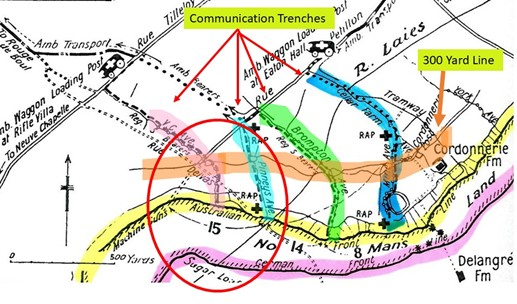
Before the main attack even began, the battalion suffered heavily. On the morning of 15 July 1916, the 58th Battalion was positioned near the front lines ahead of the 300-yard line near Fleurbaix when intense German shelling smashed the trenches and communication lines. The 15th Brigade and 58th Battalion War Diaries recorded:
“Great difficulty in evacuating killed and wounded…”
“Those missing are believed to be covered by debris.”
During the bombardment, a German raiding party also entered the Australian lines and captured a Lewis Gun from the 58th Battalion. A and B Companies suffered the worst of the attack. Between the shelling and the trench raid, 42 men were killed, 103 wounded, and 5 missing. Edward Clinch, serving with B Company, was among those killed during the bombardment near Fleurbaix on 15 July 1916, only weeks after arriving in France.
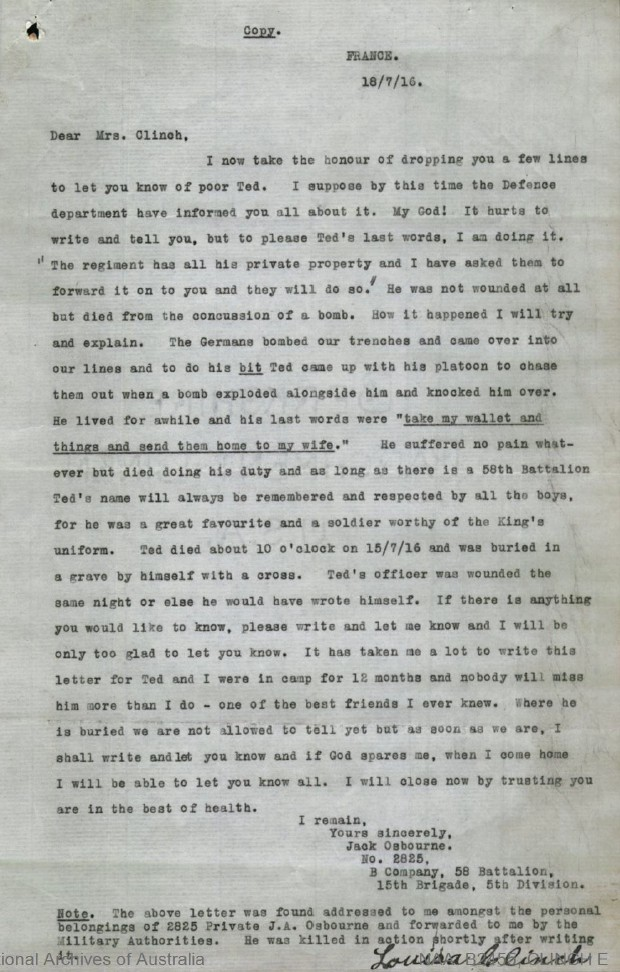
His mate, 2825 Private John Alfred (Jack) Osbourne, wrote to his wife Louisa three days later:
“The Germans bombed our trenches and came over into our lines and to do his bit Ted came up with his platoon to chase them out when a bomb exploded alongside him and knocked him over.”
Jack had trained with Ted for more than a year and knowing official confirmation may not yet have reached Australia, he gently tried to explain what had happened. He reassured her that Edward had not suffered.
"He was not wounded at all but died from the concussion of a bomb."
Jack explained that when German troops entered the Australian trenches, Edward had advanced with his platoon to drive them back.
"The Germans bombed our trenches and came over into our lines and to do his bit Ted came up with his platoon to chase them out when a bomb exploded alongside him and knocked him over."
Edward remained alive for a short time, and Jack carefully recorded the message he wanted passed on to his wife.
"He lived for awhile and his last words were 'take my wallet and things and send them home to my wife'".
The letter then became deeply personal. Jack wanted Louisa to know how highly Edward was regarded within the battalion.
"Ted's name will always be remembered and respected by all the boys, for he was a great favourite and a soldier worthy of the King's uniform."
And finally
"It has taken me a lot to write this letter for Ted and I were in camp for 12 months and nobody will miss him more than I do — one of the best friends I ever knew."
Source: NAA: B2455, CLINCH Edward – First AIF Personnel Dossiers 1914–1920
Four days later, the Battle of Fromelles would erupt across the sector, bringing even greater devastation to the men of the 58th Battalion.
The Battle of Fromelles
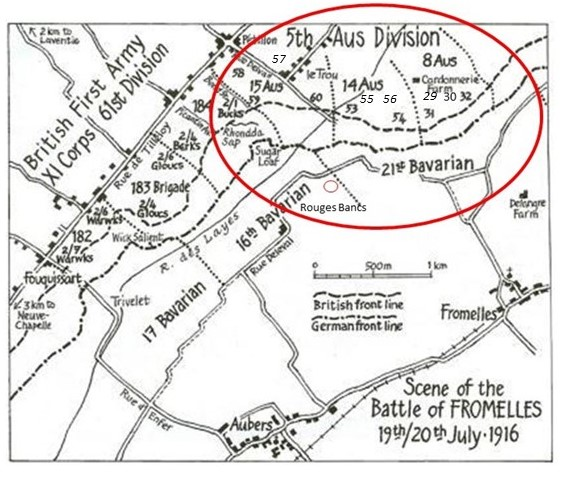
Although Ted did not live to take part in the Battle of Fromelles, his death formed part of the growing toll that marked the lead-up to the attack. Four days after he was killed, the 58th Battalion went into action on the evening of 19 July 1916 as part of the 15th Brigade's assault. The battalion's role was to carry ammunition, dig communication trenches through captured ground in No Man's Land, and reinforce the leading battalions as required. Advancing into intense machine-gun and artillery fire, the men encountered fierce resistance, particularly from the heavily fortified German strongpoint known as the Sugar Loaf. Fire from this position swept across the battlefield, inflicting devastating casualties and making it almost impossible to hold captured ground.
By the time the fighting ended on 20 July, the 58th Battalion had suffered 172 casualties. The battle itself claimed more than 5,500 Australian casualties in less than twenty-four hours, making Fromelles the worst twenty-four hours in Australia's military history. In the confusion that followed, news from France was slow to reach Australia. With casualty lists continuing to grow after the battle, many families endured days or weeks of uncertainty as official notifications gradually arrived. For Ted’s family, their grief unfolded against the backdrop of one of the AIF's greatest tragedies.
After the Battle
Among those killed during the devastating German bombardment near Fleurbaix on 15 July 1916 were Ted, George Challis, Victor Quinn, and Joseph Kelsall of the 58th Battalion. The shelling caused heavy casualties among A and B Companies and became a grim introduction to the realities of the Western Front for the newly arrived Australians. As casualty lists from France slowly reached Australia.
Ted’s family placed a death notice in The Age mourning the loss of their son and brother:
CLINCH -Killed in action in France on the 13th July, Private E. Clinch, beloved son of the late Edward and Esther Clinch, of Fitzroy.— Inserted by his sorrowing wife, brothers and sisters.
Private John Alfred “Jack” Osbourne enlisted alongside Edward in June 1915. The two men trained together in Egypt, transferred to the newly formed 58th Battalion, and served in B Company on the Western Front. Jack survived the fighting around Fleurbaix and the Battle of Fromelles, but his own war was short-lived. Promoted to Corporal, he was killed in action on 9 March 1917 and is buried at Bulls Road Cemetery, Flers. Jack's younger brother, Walter James Osbourne, had also transferred from the 6th Battalion to the 58th.
Promoted to Regimental Quartermaster Sergeant, Walter survived Fromelles before being killed in action on 27 March 1918 when a German shell struck a troop train near St. Pol-sur-Ternoise.
Following Ted’s death, Louisa moved from Mater Street, Collingwood, to Fitzroy, later appearing at Webb Street and Argyle Street addresses in military and pension records. She continued raising children in the years that followed, including Doris, who was officially recognised in Edward’s pension records as their adopted daughter. Later records suggest Louisa continued caring for or raising children throughout her life. When she died in 1953, her death notice remembered her as the mother of Doris, Nellie, and Daisy:
CLINCH. — On March 31, at Ringwood, Louisa May, dearly loved wife of the late Edward, and loved mother of Doris (Mrs. W. Smith), Nellie (Mrs. G. Llewellyn), and Daisy (Mrs. J. Wainwright), loved nana of all the children.
Ted Clinch was buried at Rue-Petillon Military Cemetery, Fleurbaix, France, Plot I, Row K, Grave 115. Unlike many men killed in the fighting around Fromelles, his grave was identified and marked.

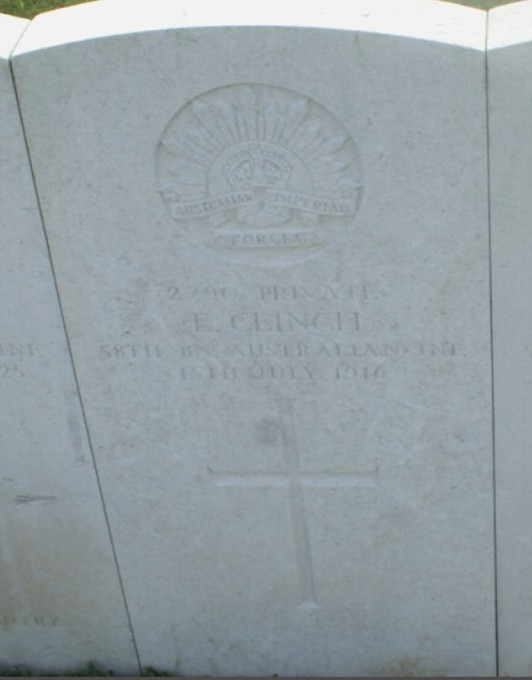
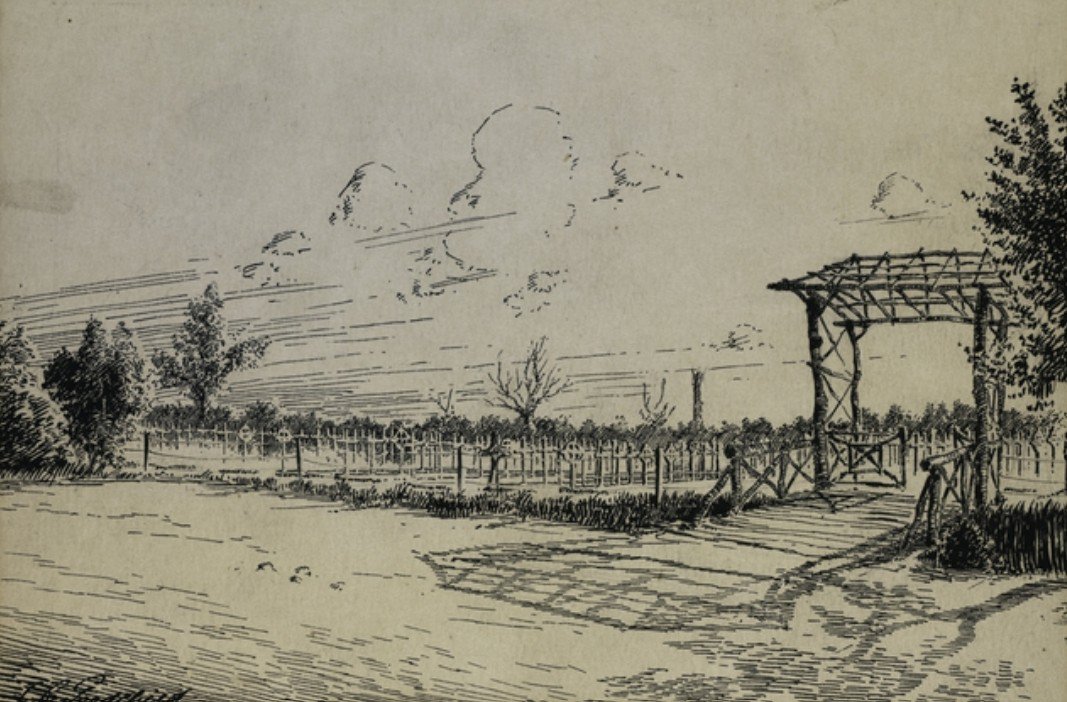
More than a century later, Ted is remembered among the men of the 58th Battalion who endured the terrible introduction to trench warfare near Fleurbaix and Fromelles in July 1916. His name remains recorded on memorials in Australia and France, and his grave at Rue-Petillon Military Cemetery stands as a lasting reminder of the cost borne by ordinary Australian families during the First World War.
The Fromelles Association would love to hear from you

Contacts
(Contact: carla@fromelles.info or geoffrey@fromelles.info).
(Contact: army.uwc@defence.gov.au or phone 1800 019 090).
Donations
If you are able, please contribute to the upkeep of this resource.
(Contact: bill@fromelles.info ).